


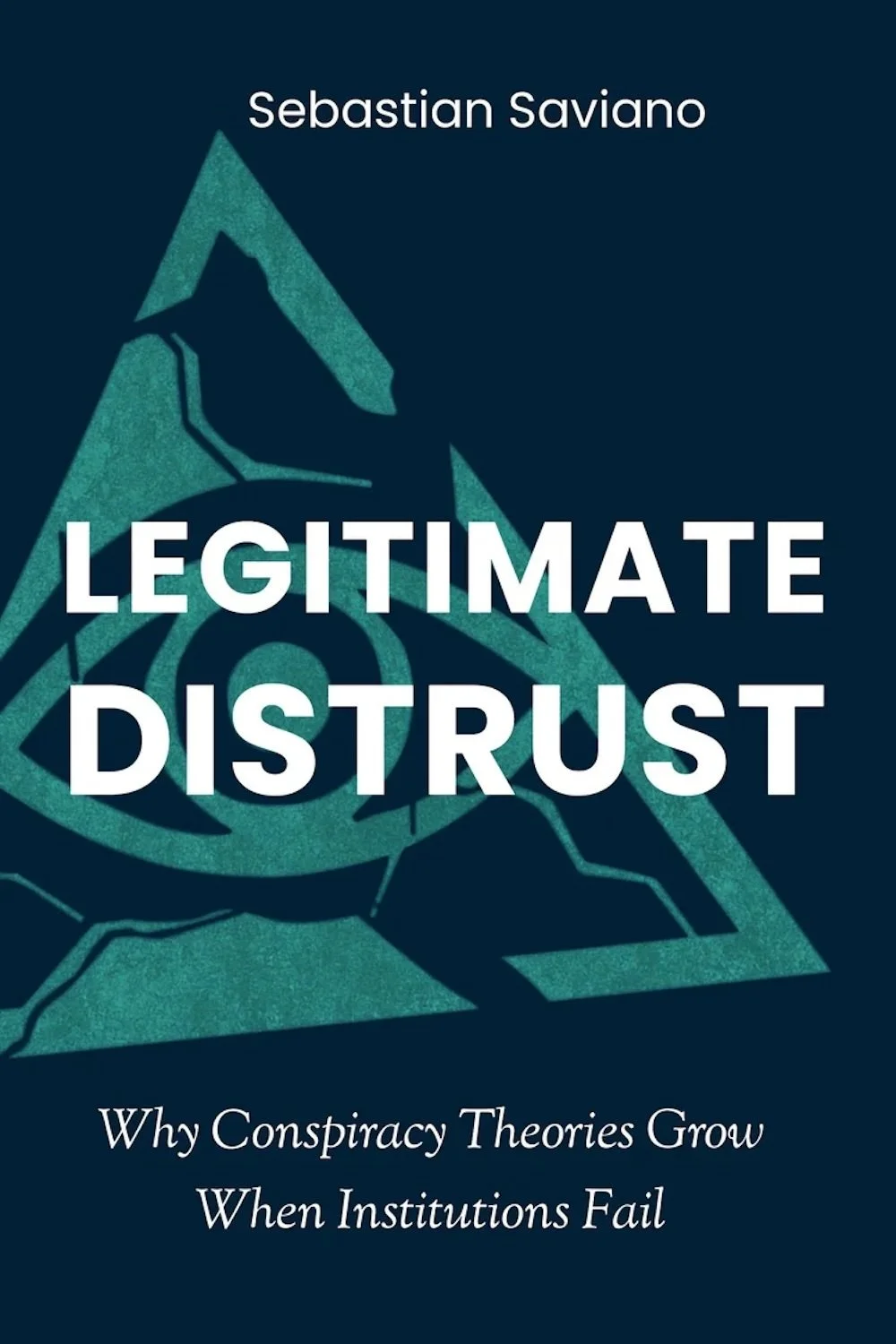
Legitimate Distrust
Why Conspiracy Theories Grow
When Institutions Fail
Book Two of The Collapse of Trust
Author: Sebastian Saviano
Publisher: Statera Press (2026)
Legitimate Distrust challenges the conventional assumption that conspiracy belief is simply irrational. Sebastian Saviano reframes it as a logical response to systemic institutional failure — arguing that when the social contract erodes, when truth is managed rather than explained, and when power operates without accountability, suspicion is not only natural. It is rational.
Drawing on political theory, sociology, history, philosophy, and psychology, the book makes a case that is both diagnostic and urgent. As Book Two of The Collapse of Trust series, it builds on The Allegiance Paradox — moving from questions of citizenship and betrayal to a deeper inquiry into the epistemology of mistrust and what its proliferation reveals about the fractures beneath civic life.
The Central Case
Conspiracy belief is rarely the root problem. It is more often a secondary adaptation to institutional environments marked by opacity, inconsistency, and consequence without accountability — a rational response to exclusion from meaning-making.
Historical betrayals matter epistemically. Documented cases of institutional deception — from COINTELPRO and Tuskegee to corporate coverups and surveillance programs — do not stay in the past. They recalibrate how future claims are evaluated and by whom.
Dismissal accelerates distrust. When authorities respond to skepticism with ridicule rather than engagement, they reinforce the very patterns of exclusion that fuel conspiratorial belief in the first place.
Not all conspiracies are theories. Some are historical facts that were once dismissed precisely because they challenged institutional credibility. The line between speculation and documented reality is more porous than public discourse typically acknowledges.
Rebuilding trust requires structural reform, not better messaging. Public confidence cannot be manufactured through communication strategy. It must be earned through transparency, accountability, and institutions that remain open to challenge and consequence.
Who This Book Is For
Engaged citizens who want to understand why mistrust is rising — and how it can be addressed without surrendering to cynicism or ideology.
Policymakers, civic leaders, and legal scholars navigating the tradeoffs between transparency, accountability, and institutional credibility.
Students and scholars in political science, sociology, law, history, and public policy seeking an interdisciplinary framework for analyzing conspiracy belief and institutional legitimacy.
Journalists, educators, and advocates looking for clear, evidence-based ways to interpret and communicate about conspiracy claims in democratic life.
The Collapse of Trust series
The Collapse of Trust is a four-volume investigation into the fracturing of civic allegiance, institutional credibility, and cultural coherence in modern democracy — tracing not outright collapse, but a quieter unraveling of legitimacy itself. The series culminates in a capstone volume integrating the arguments of all four books.